
August 10, 2026
Here’s a question that is best asked over a glass of…cider: What actually makes something a cider?
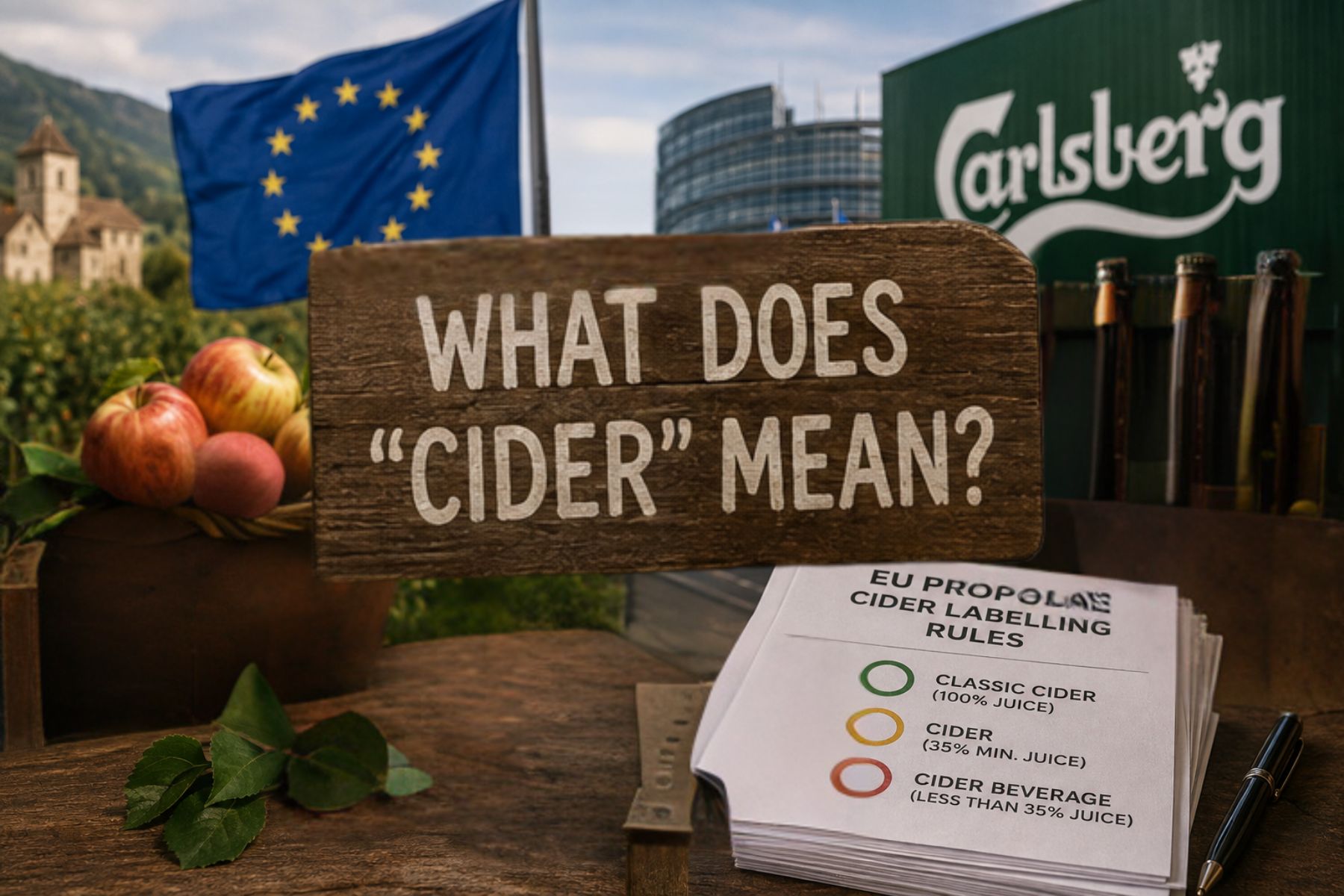
Many traditional producers, particularly in France and Spain, have been asking that question for years, urging EU regulators to adopt a clearer legal definition that distinguishes cider made entirely from fermented fruit juice from more modern cider beverages. It has been a slow-moving debate, mostly confined to policy papers and industry meetings.
Then Carlsberg stepped in.
The company behind Somersby, one of the world’s best-known cider brands, has publicly pushed back against the European Commission’s proposed labeling framework. Carlsberg did not start this argument. But its involvement has pulled what was once a quiet regulatory debate into the spotlight and raised the stakes for everyone involved.
Background
New to this story? Read our earlier coverage explaining the European Commission’s original proposal and why cider producers first raised concerns:
→ Who Gets to Define Cider? EU Draft Heads to National Representatives (June 9)
Wait, cider needs a legal definition?
In a word, yes.
Right now, if you pick up a bottle labeled “cider” somewhere in Europe, it could mean very different things. It might be made entirely from fermented apple juice, as it has been in Normandy or Asturias for generations. Or it might be a modern fruit-forward drink made with significantly less fruit juice, the style that has become hugely popular in parts of Scandinavia.
The European Commission’s proposal tries to bring greater consistency by creating three product categories: Classic Cider, Cider, and Cider Beverage, each with different production requirements.
Simple enough on paper.
In practice, the proposal has been years in the making and remains far from settled.
A Fight That Outgrew Its Original Players
For a long time, this was largely a conversation between regulators and traditional producers who felt increasingly overshadowed by mass-market products also using the word cider.
Their concern is straightforward. If drinks containing relatively little fermented fruit juice share the same name as ciders rooted in generations of orchard knowledge and regional tradition, consumers may struggle to understand the difference.
Carlsberg’s entry changes the shape of the debate without changing its origins.
Millions of consumers already know Somersby as cider, and the company argues that changing long-established definitions could create unnecessary confusion in the marketplace.
What began as a discussion among regulators, producer organizations, and traditional cider makers now includes one of the world’s largest beverage companies, whose brands are sold in dozens of countries.
That alone illustrates how important the outcome has become.
Why Nobody Has Cracked It Yet
Part of the challenge is that Europe has never had just one cider tradition.
There is the keeved cider of Normandy, the natural sidra of Asturias, farmhouse ciders from Britain, and the fruit-forward styles that dominate supermarket shelves across much of Scandinavia.
Trying to write one rulebook that fairly reflects all of those traditions was always going to take time.
The European Commission continues to consult with Member States, and no timetable has been announced for adopting final marketing standards.
Why This Matters Even If You’ve Never Set Foot in Europe
You do not need to follow EU regulations to understand why this matters.
Cider producers and consumers in the United States, Australia, New Zealand, and other growing cider markets are asking many of the same questions.
How should traditional cider be distinguished from modern cider beverages? Should ingredients determine what can legally be called cider? Or should consumer expectations play a role?
Europe simply happens to be debating those questions first and on one of the world’s biggest stages.
Whatever the final outcome, the discussion is likely to influence cider conversations far beyond the European Union.
At its core, this debate was never really about apple juice percentages.
It is about who gets to shape the meaning of one of the world’s oldest drinks.
Can one legal definition respect centuries of regional cider traditions while reflecting today’s global cider marketplace?
Europe has not answered that question yet.
But whatever it decides is likely to influence how cider is understood, marketed, and valued for years to come.
Why This Matters to Ciderville
Carlsberg’s decision to publicly engage in the debate marks an important turning point. What began as a discussion among regulators and traditional cider producers has become an international conversation involving some of the biggest companies in the beverage industry.
The proposal remains unfinished, but its influence is already being felt. As cider continues to grow around the world, the questions being asked in Brussels today are likely to surface in other markets tomorrow.
About eCiderNews™
eCiderNews™, published by Cider Chat®, delivers independent reporting, industry insights, and global cider stories for the people who grow, make, sell, serve, and enjoy cider.
Stay Connected
🍎 Subscribe to the eCiderNews newsletter for the latest cider news and analysis.
🎙️ Listen to the Cider Chat podcast for conversations with cider makers, orchardists, and industry leaders.
📬 Story tips: news@ciderchat.com
🌍 Because cider deserves its own newsroom.



You must be logged in to post a comment.